
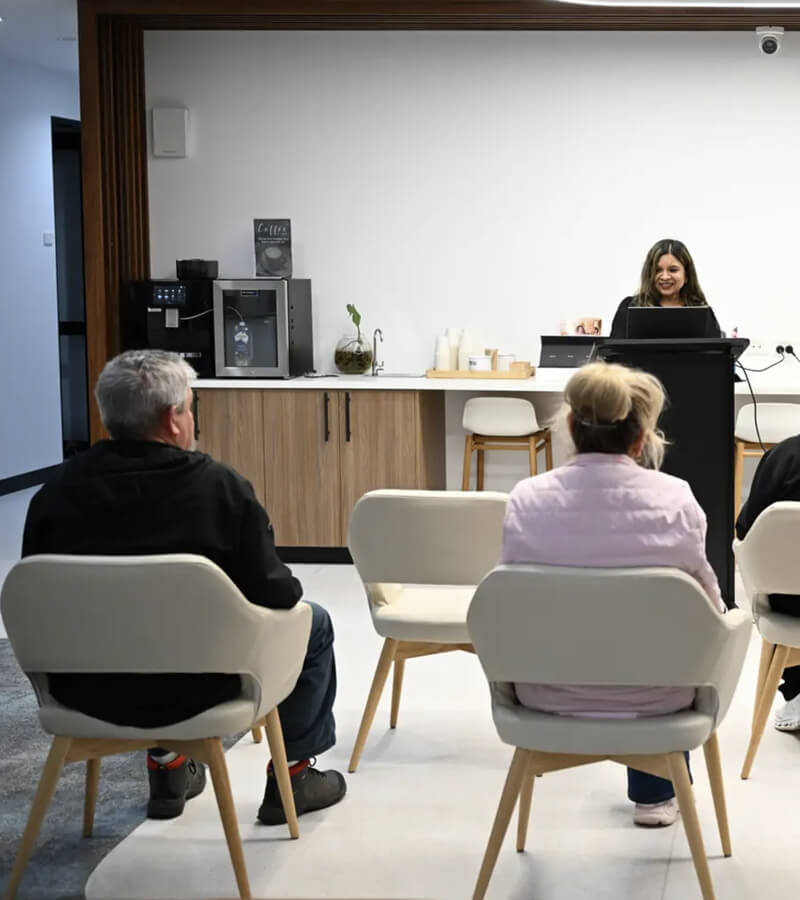
Inside our All-on-X information evening in Norlane. What an implant actually is, what the new teeth are made of, what the scan tells us, what happens on surgery day, and how long healing really takes.
We moved the coffee machine and put the chairs in a semicircle.
That is about as formal as our information evenings get.
A small group came along. A few had been putting the decision off for years. Most arrived with some version of the same three questions, and by the end of the hour all three had been asked out loud: will it hurt, how long am I without teeth, and how do I know it will work for me.
Dr Rashi Gupta ran the session. No sales pitch, nothing to sign at the door. She talked, people interrupted with questions, and the samples went hand to hand around the room.
This is the whole evening, written down, for everyone who could not get there. Treat it as general information. We cannot tell you what suits your mouth until we have examined it and looked at a scan, and results differ from one person to the next.
The short version
- An implant replaces the root. The teeth on top are a separate part with their own lifespan.
- A full arch is rebuilt on four or more implants carrying one fixed bridge, not one implant per tooth.
- Ours is a milled titanium framework with acrylic teeth, screwed on rather than cemented.
- A CBCT scan decides where the implants go, and whether the treatment suits you at all.
- Fixed temporary teeth go in within 24 to 48 hours. Nobody leaves without teeth.
- Bone needs months to fuse to the implants, and the final bridge waits for it.
- Not everyone is suitable. We will tell you if you are not.

An implant is a root, not a tooth
Start with the thing most people have back to front.
A dental implant is a titanium post placed into the jawbone, where the natural root used to sit. Over the months that follow, your own bone grows onto its surface and grips it. The word for that is osseointegration, and everything else in this article depends on it. Once the bond has formed, the post takes chewing load and passes it into the bone the way a real root does.
The teeth you can see sit above the gum, joined to the implant through a connector called an abutment.
So there are two things going on. Hardware in the bone that is meant to stay put, and a bridge above it that does the visible work and wears like anything else you use every day. Hold on to that split, because it explains everything about the maintenance later on.
An implant is not a tooth. It is a root. The teeth come later, and they are a separate part.
One missing tooth and a whole arch are different problems
We work with three implant pathways. Which one suits you comes down to what is left in your mouth and what the bone underneath will carry.
Someone always asks why we do not simply place fourteen implants and rebuild tooth by tooth. Two answers. The jaw usually will not give us the bone for it, and it is not necessary.
Where teeth have been gone a while, the bone that held them has shrunk back, and it does not shrink evenly. There are also structures we have to stay clear of. The sinus sits above the upper back teeth. A nerve canal runs through the lower jaw.
So we work with what is there. Implants go where the bone is still solid, the back ones often tilted so they catch denser bone in front of the sinus or the nerve, and a single bridge is engineered to span the lot. That is all the X in All-on-X means. The number of implants comes from your anatomy and your scan, not from a brand name.
01.
Single tooth
Single implant
One implant carrying a crown, where a single tooth is missing and the neighbours are healthy.
02.
Several teeth
Implant-supported bridge
Two or more implants carrying a fixed bridge, without cutting down the natural teeth either side.
03.
Full arch
Fixed full arch
A fixed bridge on four or more implants, commonly called All-on-4® or All-on-X. What most of the room came to hear about.
What the new teeth are actually made of
This is the point where the samples started going around the room, which was the right call. Thirty seconds holding one of these tells you more than a slide ever will.

Acrylic teeth on a titanium framework
A milled titanium bar screws onto the implants and does the structural work. The acrylic teeth are built onto that bar. The metal carries the load. The acrylic gives you the shape, the shade and the surface.
The bar is not off the shelf. It is milled for your case from the same digital plan that decided where the implants go, so the framework, the implant positions and the teeth are designed together rather than as three separate decisions. That is why the planning appointments matter every bit as much as surgery day.
It is screwed on, not cemented. From your side that makes no difference: it is fixed, it does not come out at night, and you cannot remove it. From ours it makes a large one. Screws can be checked and tightened. The bridge can come off for a proper clean or a repair and go straight back on. Cement does not give you that.
Acrylic is softer than ceramic. It is easier on the teeth it bites against, and it is straightforward to repair or adjust in the chair. In return, it wears, it can pick up stain, and it may need a reline as the gum settles and remodels underneath over the years. That is the deal with the material. We plan for it rather than letting you find out later.
Shade, tooth shape, tooth position and how much lip support you get are all settled before the final bridge is made. That is what the planning appointment and the temporary stage are for. You wear a fixed set of teeth, you talk and eat and smile in them, and what we learn from that goes into the final bridge. Material and design options are discussed at your assessment with your scan on the screen.
| Part | What it does | What it means for you |
|---|---|---|
| Implants | Titanium posts placed into the jaw, fusing with bone over months | The foundation of the arch, designed to stay put |
| Titanium framework | A milled bar screwed onto the implants, carrying the chewing load | Strength spread across the whole arch rather than tooth by tooth |
| Acrylic teeth | Built onto the framework. Shape, shade and surface | Natural appearance, and a material that is kind to the teeth it bites against |
| Screw retention | Screwed to the implants rather than cemented | Fixed for you. Removable by us for servicing or repair |
| Night guard | Provided as part of your treatment | Protects the bridge from grinding and clenching |
| Reline | Done where indicated as the tissues settle | Keeps the fit accurate as the gum remodels |


What the scan actually shows us
Not enough bone. It is the single most common reason people are told implants are off the table, and sometimes that is exactly right. Sometimes it was decided without anyone taking a proper look.
A CBCT is a three-dimensional x-ray of your jaw. A flat x-ray shows us where teeth and roots sit. A CBCT shows us how much bone is there, how thick and how dense it is, and precisely where the sinus floor above and the nerve canal below run through it.
That is what lets the implant positions be planned before surgery rather than worked out during it. We can see where the solid bone is, decide how far the back implants need to be tilted to reach it, and know in advance whether grafting is needed and how much. It is also what tells us honestly whether the treatment suits you at all, which is a conversation better had at the start than halfway through.
You see the scan on the screen at your assessment. Most people find their own jaw a good deal more convincing than anything we could say about it.
Surgery day, start to finish
People brace themselves for surgery day. It is usually the most predictable part of the whole thing, because by the time you get there everything has been worked out on the scan.
Teeth in the arch that cannot be saved come out. The implant sites are prepared and the implants go in where the plan says. If the bone needs support, grafting material goes in at the same time. Then we close the sites and you go home with written instructions, medication where it is appropriate, and a number to call if something worries you at nine that night.
Nerves came up early in the evening and kept coming up. A full arch is normally completed in one surgical visit, and for suitable patients we have sedation options through our partner facility, Geelong Sleep Dentistry, including IV sedation and general anaesthesia. How long you are in the chair depends on how many teeth are coming out, whether you need grafting, and whether we are treating one arch or both. You get that estimate in writing, for your own case, before anything is booked.
CGF, and what it actually is
One of the cases covered on the night used CGF, short for concentrated growth factors. We take a small sample of your blood on the day and spin it in a centrifuge, which concentrates the platelets and the growth-factor-rich fibrin out of it. That concentrate can then go in alongside grafting material at the surgical site, to support your own healing.
It is your own biological material, prepared here, used the same day. It is not needed in every case and it does not replace careful surgery or good healing conditions. Where we plan to use it, we discuss it and you consent to it beforehand.

Healing runs on two clocks
Two things are healing at once, and they do not move at the same speed.
Gum heals first. Expect swelling and bruising for the first few days, usually worst around day two or three, then settling. Discomfort is managed with what we prescribe. Most people are eating comfortably on soft food well before the swelling has gone.
Bone takes months, and it cannot be hurried.
Which is why the teeth arrive in stages. Fixed temporary teeth go in within 24 to 48 hours of surgery, so nobody walks out of here without teeth. That temporary set earns its keep. You test the bite, the tooth position and the lip support in real life, and all three get refined before anything is made final. The final bridge is fitted once healing has matured, months rather than weeks. Your own staging is written into your plan before you start.
Food moves in stages too. Liquids, then very soft, then gradually back towards normal as healing allows. And smoking genuinely compromises implant healing, so we have that conversation directly rather than tiptoeing around it.
Bone takes months. No amount of wanting it finished changes that, which is exactly why the teeth come in stages
The full pathway, from first call to final teeth
This slide stayed up the longest, because it answers the question sitting underneath all the others. What am I actually signing up for?
| Stage | What happens |
|---|---|
| Initial assessment, including CBCT | A 3D scan of your jaw, a conversation about what you want and expect, a treatment plan built around it, and time for your questions. |
| One-hour planning appointment | Clinical photographs and digital scans, then the smile design itself. Tooth shape, tooth position, how much shows when you smile and when you speak. |
| Surgery day | Teeth that cannot be saved come out, implants go in, grafting where it is indicated. |
| Temporary fixed teeth, 24 to 48 hours | Fixed temporaries are inserted and assessed. You leave with teeth. |
| Final fixed teeth | The definitive bridge goes in once healing has matured and the design is confirmed. |
| Reviews and maintenance | Post-surgical reviews, a three-month review, and a check-up and clean inside the first six months. |

One case we walked through
Upper and lower, under sedation
Rather than talk in the abstract, Dr Rashi took the room through a de-identified case. A woman in her early forties who wanted fixed upper and lower teeth and did not want anything removable.
The plan was upper and lower full-arch bridges on implants, completed under sedation. Concentrated growth factors from her own blood were used to support grafting at the surgical sites. Both arches were treated, staged through temporary and then final fixed teeth as healing progressed.
We chose that case because it is a realistic picture rather than an ideal one. Two arches, grafting needed, sedation used, a timeline running over months. It is an example of a treatment pathway, not a promise. Outcomes vary between patients, every case carries risks as well as benefits, and what suited her may not suit you.

Living with a fixed bridge
A fixed bridge stays put day and night, so looking after it takes a different routine to anything you may have used before. It sits just above the gum, and that junction is where the work happens.
The water flosser does most of it, and we set you up with one rather than leaving you to work it out on your own. Used daily, it flushes under and around the bridge where a brush cannot reach. Interdental brushes and superfloss threaded underneath handle the rest, and you still brush everything you can see.
And yes, food gets under there. That question came up twice on the night. It happens most in the early months, while you are learning the shape of the thing and the tissues are still settling. It is managed rather than eliminated, which is most of the reason the daily routine and the six-monthly maintenance visits matter.
Two habits protect the result. Wear the night guard if you grind or clench, because a bridge concentrates that force instead of spreading it across separate teeth. And keep your reviews. We check screws, bite contacts and tissue health at those appointments, and a small problem found early is a very different job from the same problem found late.
When we say no
An evening that only covers the upside is not much use to anyone. So we spent time on the other side of it.
Before anyone is treated we look at how much bone is there and what quality it is, whether gum disease is active, whether you smoke, whether diabetes is present and how well it is controlled, whether you grind heavily, what medications you take, with antiresorptive and bone-modifying drugs mattering most here, and any medical condition that affects healing or makes surgery and sedation riskier.
Some of those rule the treatment out. More often they change the plan, the staging or the risk conversation. And for some people the better answer is keeping and repairing the teeth they still have, or another option altogether, which we would talk through with you at the time. We reach that conclusion with imaging in front of us, and we write down the reasoning rather than delivering it as an opinion across the desk.
Everything the room asked
What are All-on-4 and All-on-X dental implants?
Both describe a fixed bridge replacing a full upper or lower arch, supported by implants placed in the bone you still have. All-on-4® is a specific branded protocol using four implants. All-on-X is the general term, used when the number of implants is decided case by case, which may be four or more. Same principle either way: implants where the bone will take them, one connected bridge across the top.
How many implants will I need?
It comes out of the scan rather than out of a brochure. We look at how much solid bone you have and where it sits, then work out how many implants that bone will properly support and at what angles. Four is common for a full arch. More than four is not unusual. You are told the number, and the reasoning behind it, in your written plan.
Do dental implants hurt?
The surgery is done under local anaesthetic, with sedation or general anaesthesia available for suitable patients. Afterwards, expect discomfort, swelling and bruising for several days, managed with what we prescribe. Individual experience varies, and we go through the recovery with you in detail before you consent to anything.
Am I too old for dental implants?
Age on its own is rarely the deciding factor. What matters is how well you heal, your general medical history, the medications you take and the bone we have to work with. Those are assessed individually, and they are the reason two people the same age can get different answers from us.
How long do dental implants last?
Implants have a well-documented record of long-term survival in the published literature, but no implant carries a guarantee, and longevity depends heavily on bone health, gum health, grinding forces, smoking and maintenance. Worth separating the two parts again: the implants in the bone and the bridge on top have different lifespans, and the bridge is a wearing component that will need maintenance and, in time, renewal.
Does food get stuck under All-on-X implants?
It can, particularly early on. Daily water flossing, interdental cleaning and regular professional maintenance are how it is handled, and the bridge design itself is worked on to keep cleaning practical.
If you missed this one
The next evening, or just come in.
These run in the lounge at our Norlane practice, with coffee and a small group. They are free, there is no obligation, and nobody leaves with a treatment plan they did not ask for.
If you would rather skip straight to an answer about your own mouth, the starting point is an implant assessment with CBCT imaging. After it you get a written plan setting out your options, the risks and the alternatives, with everything explained before you decide anything.

Important information
This article is general information only and does not constitute dental or medical advice, a diagnosis, or a treatment plan. Full-arch implant treatment is a surgical procedure that carries risks as well as benefits. Suitability is determined only after a clinical assessment including imaging. Outcomes vary between patients, and the results of any individual case described here may not be achieved in another patient. All-on-4® is a registered trademark of its respective owner and is referred to here for descriptive purposes only. Any patient images or case details published must be accompanied by written patient consent.
Dentistry Designed Around You.