
The short answer: All-on-X is a way of replacing a full arch of teeth with a fixed set of new teeth supported by a small number of dental implants. Whether it may suit you depends on your gums, your jawbone and your general health, which is why every journey begins with a full assessment. Here is what the process usually involves at our Norlane practice, so you know what to expect before you book.
- What it is: fixed teeth supported by a small number of implants, planned around your jaw.
- Who it may suit: people missing most of their teeth in one or both jaws, or whose remaining teeth are failing.
- How long it takes: treatment happens in stages, and healing takes months, not days.
- What to weigh up: the benefits, the risks, the alternatives and the costs, all explained before you decide.
What is All-on-X?
Dental implants are small titanium posts placed in the jawbone to act as artificial tooth roots. With All-on-X, a small number of implants are positioned in each jaw to support a full arch of fixed teeth. How many implants are used, and where they are placed, is planned around your jaw and your needs.
Unlike a removable denture, the new teeth are fixed in place. They are cared for differently, and your dentist will show you how. If you would like the overview first, our All-on-X dental implants page explains the treatment in more detail, and you can meet the clinician behind it on the Dr Rashi Gupta implant and full-arch dentistry page.
Who may be suitable for All-on-X?
There is no single profile. People usually start exploring All-on-X because they are missing most of their teeth, or because the teeth they have left are unlikely to be saved. Suitability is confirmed after an assessment, and dentists look at several things:
- Jawbone: enough healthy bone is needed to hold implants, and scans help measure it.
- Gum health: active gum disease usually needs to be treated first.
- General health: conditions such as diabetes, osteoporosis and bleeding disorders, and some medications, can affect healing and risk.
- Smoking: smoking is linked to a higher risk of complications.
Both healthdirect and the Australian Dental Association describe these factors. If All-on-X turns out not to suit you, that is not a dead end. Your dentist can explain the other options that may.
What happens at your first All-on-X consultation?
A good first consultation is mostly a conversation, and you are not expected to decide on the day. It usually covers:
- Your goals and concerns. What you would like to change, and any worries about surgery, comfort or timing.
- Your health history. Bring a list of your medications and any medical reports. New patients can complete our medical history form beforehand.
- A clinical examination. Your teeth, gums, bite and jaw joints are checked.
- Scans and imaging. 3D scans such as CBCT imaging help show bone volume and anatomy.
- A discussion of your options. This includes All-on-X and other approaches, with the risks and benefits of each.
- Costs and payment. Your plan is explained clearly, and our payment plan options are available to discuss.
How does All-on-X treatment work?
Every plan is different, but the journey generally moves through these stages:
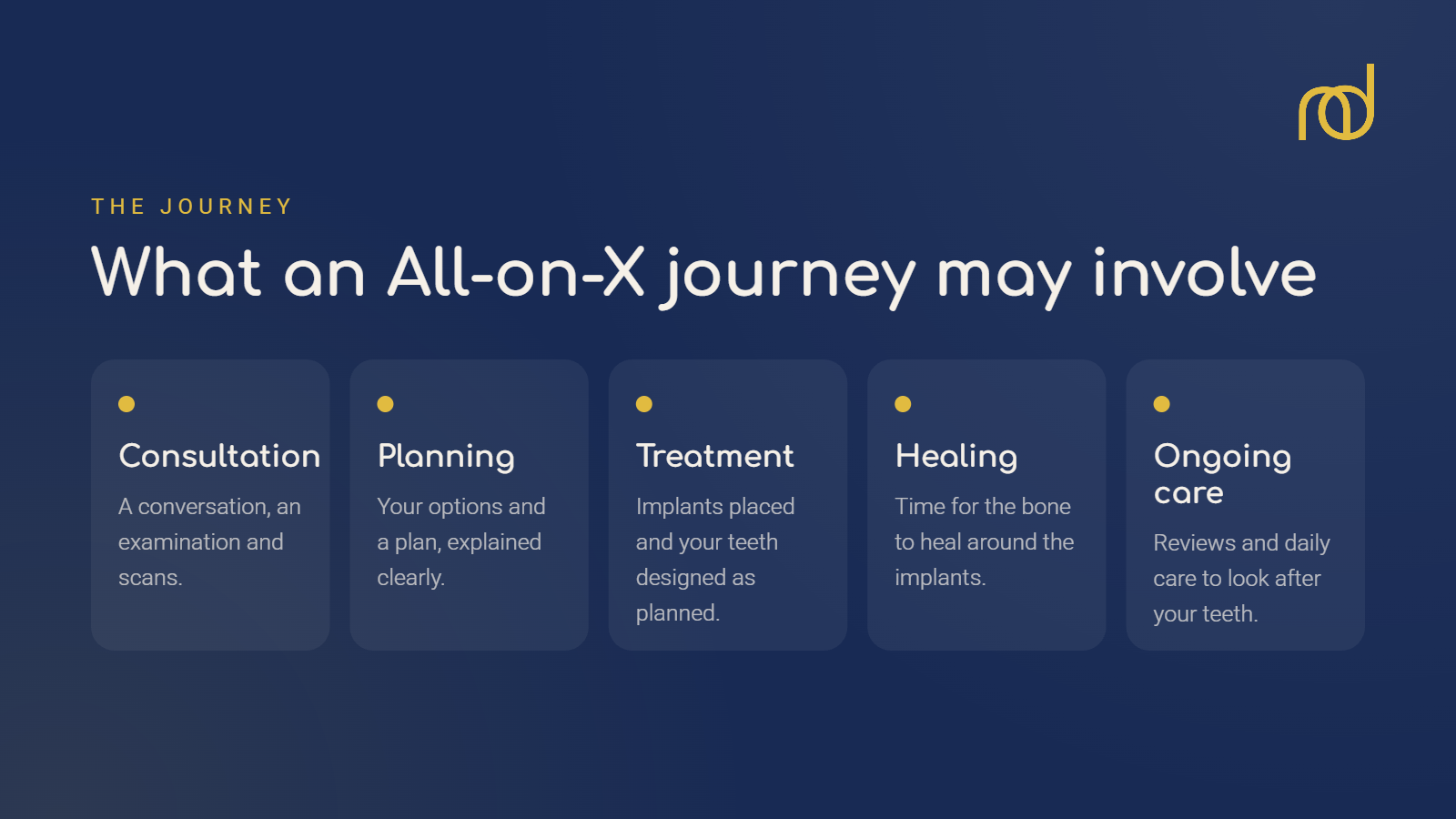
- Planning. Using your scans, your dentist maps where implants may be placed and designs your new teeth.
- Treatment day. Implants are placed in a surgical procedure, usually with local anaesthetic. Some patients choose sedation options for comfort, and any teeth that cannot be saved are removed as part of your plan.
- Healing. Bone needs time to grow around the implants. General health sources describe about three months for this to happen, but full-arch timeframes vary. Your dentist will explain what you will wear while you heal and when your final teeth are made.
- Final teeth. Once healing has been assessed, your final teeth are fitted and the bite is checked.
- Ongoing care. Regular reviews and professional cleans help look after your implants over time.
What are the risks of All-on-X?
All surgery carries risk. Healthdirect lists infection, nerve damage, sinus problems and damage to nearby teeth as possible complications of implant treatment. The Australian Dental Association also notes that implants can develop peri-implantitis, a gum condition causing inflammation and bone loss that, if untreated, can lead to an implant becoming loose. Outcomes vary from person to person. Your dentist should explain the risks, benefits and alternatives in plain English before you agree to anything.
How does All-on-X compare with dentures or single implants?
Removable dentures sit on the gums and are usually taken out for cleaning and overnight. Healthdirect notes that most people need several months to adjust to them. Single implants replace one tooth at a time and suit different situations, which you can read about on our dental implants page. All-on-X is designed to replace a full arch with fixed teeth. Each option has trade-offs in comfort, maintenance, treatment time and cost, so it is worth talking them through. Our page on dentures in Norlane covers the removable option.

Looking after your teeth afterwards
Implants and fixed teeth still need daily care. The Australian Dental Association advises brushing twice a day, cleaning between teeth every day, and keeping up regular check-ups and professional cleans. Your team will show you how to clean around your new teeth and will plan follow-up visits with you.
Costs and payment
Costs depend on your plan, so they are explained after your assessment rather than quoted before we understand your needs. Payment options are outlined on our payment plans page, and you are welcome to ask about them at any point.
Frequently asked questions about All-on-X
Is All-on-X suitable for everyone?
No. Suitability depends on your jawbone, gum health, general health and goals, and it is confirmed after a clinical assessment. If All-on-X does not suit you, your dentist can explain other options.
How long does healing take?
General health sources describe about three months for bone to grow around implants, although full-arch plans and individual healing vary. Your dentist will explain the timeframe for your plan.
Will I need sedation?
Local anaesthetic is normally used for implant surgery. Sedation options may be available if you feel anxious, and you can discuss them at your consultation. You can read more about sedation dentistry at Norlane.
What is the difference between All-on-X and single implants?
A single implant replaces one missing tooth. All-on-X uses a small number of implants to support a full arch of fixed teeth. Which approach may suit you depends on how many teeth are missing and the health of your jaw and gums.
What should I bring to my first appointment?
A list of your medications, any relevant medical reports, your health fund details and any questions you have. A family member or friend is welcome to come with you.
Want to talk it through?
If you would like to discuss whether All-on-X may suit you, you can request an appointment online or call us on (03) 5278 2666. You may also like to look at our All-on-X information sessions, or read about what happened at one of our information evenings.
General information only. This article is not a substitute for advice from a registered health practitioner. Suitability for any treatment is confirmed after a clinical assessment, and all treatment carries risks and benefits. Outcomes vary. If you have concerns about your health, speak with your dentist or doctor.
Written by the Norlane Dental team.
Dentistry Designed Around You.