
The short answer: a dental implant is a small post, usually made of titanium, that is placed in the jawbone to replace the root of a missing tooth. If you are exploring dental implants in Geelong, it helps to know that once the implant has healed it can support a crown, a bridge or a denture, and that whether it may suit you depends on your jawbone, your gums, your general health and your goals. This is confirmed after a clinical assessment and 3D imaging.
- What it is: a post that acts as an anchor for one replacement tooth, or for several teeth.
- Who may be suitable: adults who are missing one or more teeth, have healthy gums and enough jawbone, or who may be suitable for preparatory treatment first.
- How long it takes: usually several months from planning to the final tooth, because the bone needs time to heal around the implant.
- What to expect: a consultation, 3D imaging and a written treatment plan, then staged treatment with comfort options available.
- The first step: a conversation about your options, with time to think before you decide.
What is a dental implant?
A dental implant replaces the root part of a missing tooth. The post is placed in the jawbone and, over several months, the bone grows around it so that it becomes a stable anchor. A connector called an abutment is then attached and the replacement tooth is fitted on top. The replacement may be a single crown, a bridge that spans several teeth, or a denture that clips onto implants.
Implants can replace one tooth, several teeth in a row, or support a full arch of teeth. This guide focuses on single and multiple tooth implants. If you are missing most or all of the teeth in one jaw, you may also like our guide to All-on-X dental implants in Geelong or our explainer on full mouth dental implants.
Who may be suitable for dental implants?
Many adults who are missing a tooth may be suitable, but it always depends on the individual. Your dentist will usually look at:
- Jawbone: there needs to be enough bone to hold the implant, or you may be suitable for a bone graft first.
- Gum health: gum disease needs to be treated and under control before an implant is placed.
- General health: some medical conditions, medicines and habits such as smoking can affect healing, so it is important to share your full medical history.
- Age and growth: implants are generally considered once the jaws have finished growing.
- Daily care: a regular routine of brushing, cleaning between your teeth and attending check-ups supports the long-term health of an implant.
This is general information only and is not a diagnosis. You can complete our medical history form before your visit so that your dentist has the full picture.
What happens at your first consultation?
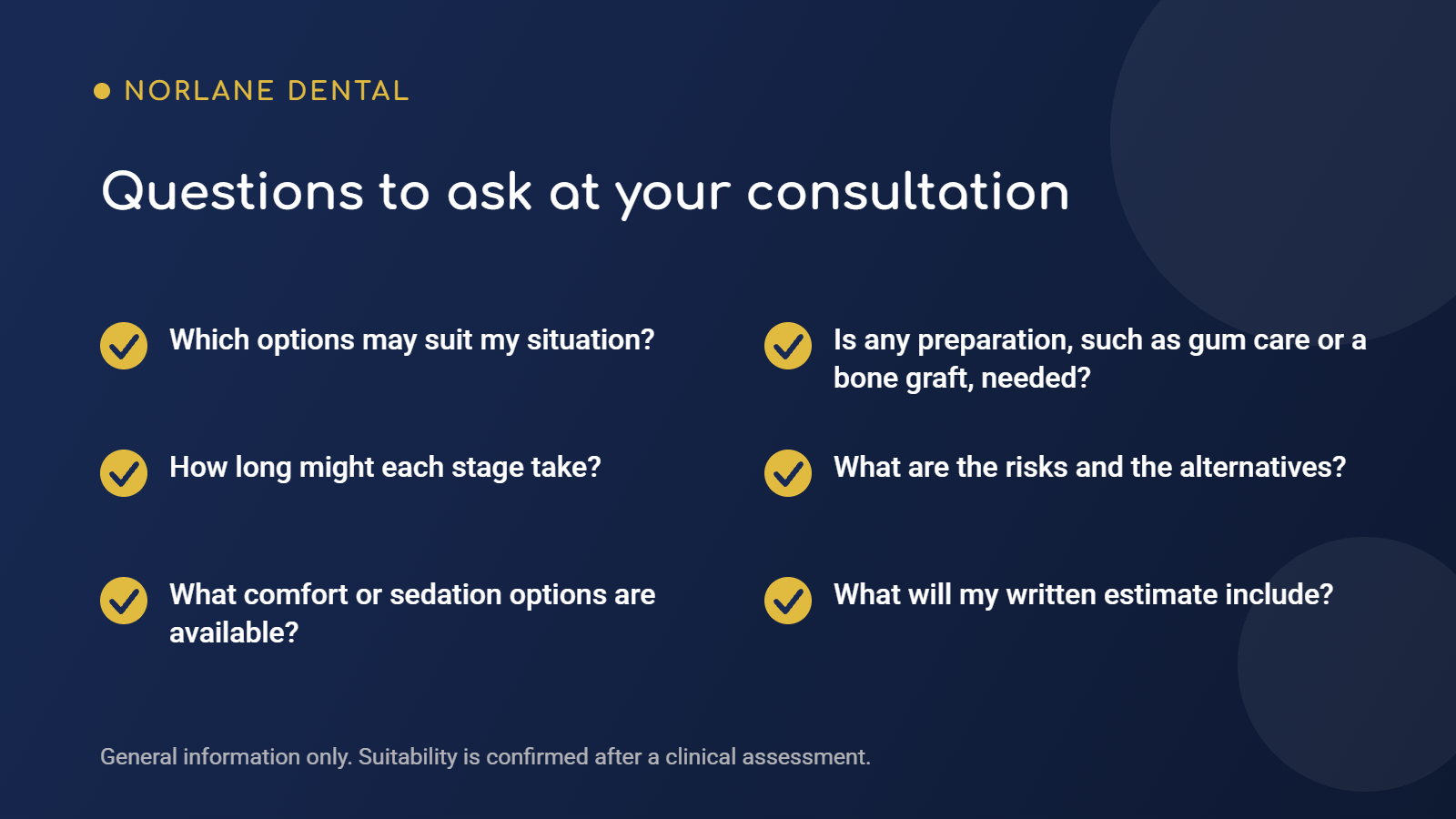
Your first visit is about understanding your situation, not committing to treatment. It usually includes:
- A conversation about your goals, concerns and medical history.
- A clinical examination of your teeth, gums and bite.
- 3D imaging (CBCT) where appropriate, which helps your dentist assess the amount and position of bone and plan placement carefully.
- A discussion of the options that may suit you, including the alternatives.
- A written treatment plan and estimate, so you can take time to consider it.
If you feel anxious about dental care, tell us at the start. There are comfort and sedation options that can be discussed, and you can read more in our guide to sedation dentistry in Geelong.
The stages of treatment
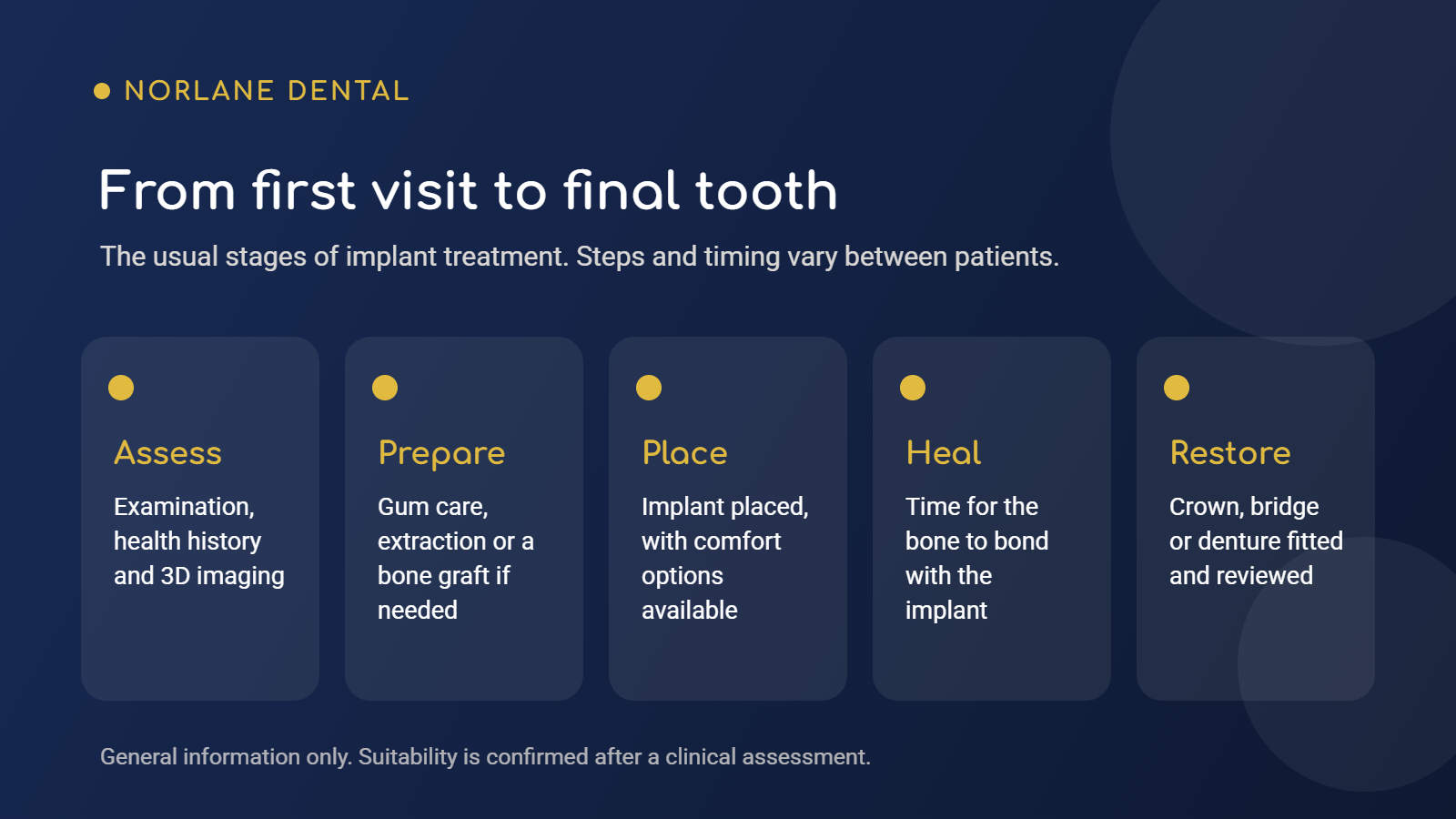
Every plan is tailored to the individual, but treatment commonly follows these stages. Timeframes vary between people.
- Assessment and planning: an examination, imaging and a written plan.
- Preparation if needed: this may include treating gum disease, removing a tooth that cannot be saved, or a bone graft to build up the site.
- Implant placement: the implant is placed in the jawbone, usually with local anaesthetic, and sedation options can be discussed. Your dentist will give you instructions for the first days afterwards.
- Healing: the bone needs time to bond with the implant. This often takes around three months and sometimes longer. A temporary tooth may be possible in some situations.
- Fitting the replacement tooth: an abutment and the final crown, bridge or denture are made and fitted, with attention to your bite and to how the tooth looks.
- Review and maintenance: regular check-ups and professional cleaning help your dentist monitor the implant and the surrounding gum.
In some cases an implant can be placed soon after a tooth is removed, and in others it is safer to wait for the area to heal. Your dentist will explain which approach may suit you.
Single tooth, several teeth or a denture: your options
Single tooth implant
Replaces one missing tooth with an implant and a crown, without the need to reshape the neighbouring teeth.
Implant-supported bridge
A bridge held by implants can replace several missing teeth in a row without needing an implant for every tooth.
Implant-supported denture
Implants can add stability to a removable denture, which may make eating and speaking more comfortable for some people. You can read about our dentures too. Our dental implants page explains each option in more detail.
Risks and things to consider
All dental treatment carries risks as well as benefits, and your dentist will talk these through with you before you decide. Possible risks and complications include:
- Infection, swelling, bruising or bleeding around the treatment site.
- An implant that does not bond with the bone. This is uncommon, but it can happen and may mean the implant needs to be removed.
- Injury to nearby nerves, teeth or tissues, or a change in sensation.
- Sinus problems when an implant is placed in the upper jaw.
- Inflammation of the gum and bone around an implant (peri-implantitis), which is one reason daily cleaning and check-ups matter.
- Mechanical problems over time, such as a loose screw or a chipped crown.
Smoking, poorly controlled diabetes, gum disease and some medicines can raise the chance of complications. Outcomes vary between patients and no result can be promised.
Alternatives to dental implants
- Dental bridge: a replacement tooth anchored to the teeth on either side of the gap, which usually involves reshaping those teeth.
- Removable partial or full denture: a removable option that does not involve placing implants.
- Leaving the gap: some people choose not to replace a tooth, but nearby teeth can drift and the bite can change over time, so it is worth discussing.
- Implant-supported options for more teeth: bridges, dentures or a full arch approach when several or all teeth are missing.
Each option has advantages and limitations, and your dentist can help you weigh them up for your situation.
Aftercare
Your dentist will give you written instructions, but general principles include:
- Follow the advice about soft foods and keeping the area clean in the first weeks, which may include a prescribed mouthwash.
- Brush gently twice a day and clean between your teeth and around the implant every day, as advised.
- Avoid smoking, which can affect healing and the long-term health of the implant.
- Attend regular check-ups and professional cleans so that early signs of gum inflammation can be managed.
- Tell your dentist if you grind your teeth, as a night guard may be recommended.
- Contact us if you notice ongoing pain, swelling, bleeding or a loose tooth.
Costs
The cost depends on the number of implants, the imaging and any preparatory treatment such as a bone graft, the type of replacement tooth and materials, and any sedation. For that reason we do not publish a single price. After your assessment we can provide a written estimate, and you can ask about our payment plan options. Health fund cover for implants varies by fund and policy, so check with your fund before you decide.
Frequently asked questions
How long do dental implants take?
From planning to the final tooth, treatment often takes several months, mainly because the bone needs time to heal around the implant. The timeline depends on whether preparatory treatment is needed, how you heal and the type of replacement tooth. Your dentist can give you an estimate after your assessment.
Is the implant procedure painful?
The area is numbed with local anaesthetic so that treatment is designed to be comfortable, and sedation options can be discussed if you feel anxious. Some soreness, swelling or bruising afterwards is common, and your dentist will explain how to manage it.
How long do dental implants last?
It varies and cannot be promised. Longevity depends on factors such as gum health, how well the implant is cleaned, smoking, your bite and regular check-ups. Looking after your implant and attending reviews helps your dentist pick up problems early.
Can I have an implant if I have had gum disease or have lost bone?
Possibly, but it depends on your situation. Gum disease needs to be treated and kept under control first, and a bone graft may be an option when there is not enough bone. Your dentist will assess this with a clinical examination and 3D imaging.
Will my health fund cover dental implants?
Cover varies by fund, policy, waiting periods and annual limits, and we cannot confirm it for you. Ask us for an itemised treatment plan and check the details with your health fund before you decide.
Want to talk it through?
If you would like to discuss whether dental implants may suit you, you can request an appointment online or call us on (03) 5278 2666. For independent patient information, see healthdirect and the Australian Dental Association’s teeth.org.au.
This article is general information only and is not a substitute for advice from a registered health professional. Suitability, risks, benefits and costs depend on your individual situation and are confirmed after a clinical assessment. All dental treatment carries risks, and outcomes vary between patients.
Written by the Norlane Dental team.
Dentistry Designed Around You.